 Tucked amongst the fields and prairie you’ll find communities rich in culture and heritage and classic buildings listed on the National Register. Home to local festivals and museums, U.S.-Dakota War sites, local museums chock full of rural artifacts and stories, the Fagen Fighters World War II Museum, and some of Minnesota’s renowned authors and artists; the land is a true reflection of its rich history. We invite you to explore our history, and make memories of your own to last a lifetime.
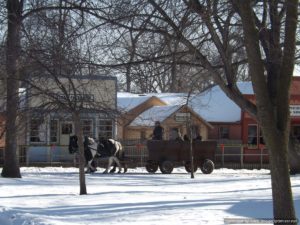 Situated on 20 acres, in Montevideo, MN; Historic Chippewa City is home to 24 buildings replicating a late 1800’s village, complete with town square and boardwalk as well as a centrally located bandstand/gazebo. Visit our authentic log cabins, 1880’s church, Millinery Shop, Blacksmith Shop, General Store and many others. Historic Chippewa City, a sure hit for all ages. Portions of the movie “Sweet Land” were filmed here, as was the PBS documentary “Death of a Dream”. Terry Redlin was so inspired by it, you’ll see his Doctor series features the Chippewa Bank Building, and many of his log homes replicate those at this site.
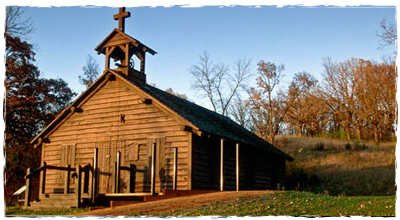
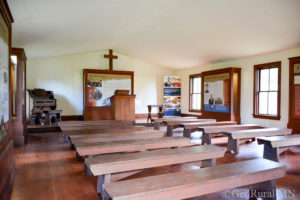 The Lac qui Parle mission was the first church bell tolled in Minnesota and where the Bible was translated into the Dakota language at the Lac qui Parle Mission, located 6 miles north of Montevideo, overlooking beautiful Lac qui Parle Lake. Walking paths and interpretive signs will lead you through the area where a small group of Protestant missionary families lived. Inside the reconstructed WPA building, exhibits describe the missionaries and their work, the Dakota people and Joseph Renville, the man who linked their worlds. Come, ring the church bell and hear echoes of our past!
(No admission required. Free parking.)
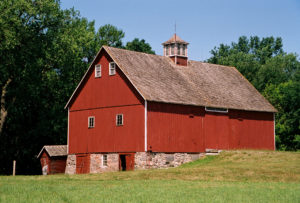 Swensson Farm is located 6 miles east of Montevideo, this turn-of-the-century 22 room brick farm home sits on a 17 acre farmstead. See the large timber-framed barn built in the 1880’s, the grist mill remains and private family burial plot. The unique barn features an elaborate system of wind-bracing and notching which attests to Swensson’s skills as a designer and builder. Your self-guided tour through the Swensson family home will be highlighted by the chapel located on the second floor.
Olof Swensson was one of Minnesota’s most innovative immigrants, and this family homestead epitomizes the immigrants dream. Join us for a visit into history! Many parts of the movie “SweetLand” were filmed here. DVD’s of the movie are still available. Email us.
(Admission required. Free parking.)
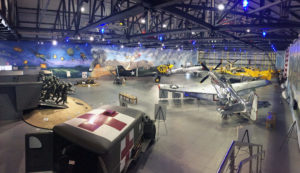 Fagen Fighters is the newest museum in Granite Falls, located at the Lenzen-Roe Memorial Airport. Construction began in April of 2011. Recently completed, the museum consists of two hangars, a WWII Quonset hut and a WWII control tower. The newest hangar and flagship of the museum is a 15,000 sq ft. brick, tornado-proof structure. Be transported in time to the 1940’s era for a fantastic self-guided WWII experience. The museum is home to the pristine collection of WWII trainer and fighter aircraft restored and owned by Fagen Fighters. The collection includes two P-51 D Mustangs, a Lockheed P-38, a P-40, a BT-13, a PT-19, a PT-22, and a PT-26. Fully operational, authentic WWII ground vehicles are proudly displayed among the aircraft. The very rare WACO CG-4A glider used to silently transport troops during WWII is among the displays.
A mural by acclaimed artist Dave Reiser depicting Utah Beach during the D-Day Allied Invasion of Normandy, France, plays a prominent role in the museum. Bronze sculptures of the Army’s 4th Infantry’s soldiers are prepared for combat as they land in a Higgins’ boat bringing the Ivy Division’s motto “Steadfast and Loyal” to life. A library overlooking the museum’s first floor containing WWII books and documents collected over many years is a work in progress. Touch screens throughout the museum give visitors an interactive experience. Authentic uniforms and artifacts are displayed throughout.
($10 per person donation suggested.)
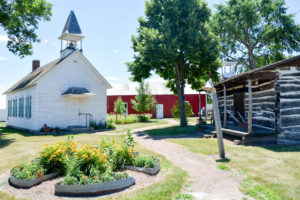 The Lac qui Parle History Center’s mission is to represent visually and chronologically the priceless heritage of Lac qui Parle County, Minnesota, which includes Lac qui Parle State Park, and the towns of Bellingham, Boyd, Dawson, Louisburg, Madison, Marietta and Nassau. Lac qui Parle (locals pronounce it Lak kwa Par-uhl ) is a French translation of the native Dakota name, meaning “lake which speaks” and is a reference to a lake formed by the widening of the Minnesota River along the northeastern border of the county. Consisting of six buildings, including an Educational Museum/Research Library, a furnished log cabin and rural schoolhouse from the 1800’s, an agricultural machinery building, a gas station and The Robert Bly Study where Madison’s native son, Minnesota’s First Poet Laureate, did much of his early writing.
(Admission free-will donation.)
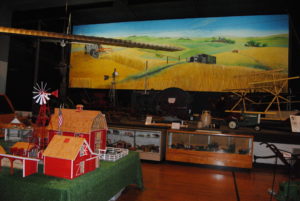 The Minnesota Machinery museum features five large buildings (26,000 sq ft) on a beautiful six-acre site. Its mission is to recapture a century of stories about farm life. Implements, tools, tractors and gas engines in mint condition along with rural art, help you look back to an era when neighbors worked together to harvest their crops, raise barns and build a better life for their families. Enjoy an afternoon browsing on your own or guided tours always available. (Admission free-will donation.)
 The Yellow Medicine County Historical Society has a Family History Lab that is open to everyone having ancestors who lived or came from Yellow Medicine County. The lab has computers with shortcuts to Ancestry.com and a large collection of county history books, church history books, printed family histories, history on schools, and township histories all relating to Yellow Medicine County.